

[BJOI2014] 路径
Description
On an undirected graph with nodes (no self-loops and no multiple edges), each node carries one symbol, which can be a digit or one of the symbols '+', '-', '*', '/', '(', ')'. Count how many walks that visit exactly nodes produce an arithmetic expression when the symbols encountered along the walk are concatenated. The start and end nodes can be chosen arbitrarily.
An arithmetic expression is a sequence of numbers connected by operators. Parentheses can be inserted into the expression to indicate the order of operations.
Note that you must handle various cases:
- Numbers must not have leading zeros unless the number is exactly .
- A minus sign can act as a unary negative sign only when there is neither an operator nor a digit immediately before it.
- Parentheses can be added arbitrarily (but empty parentheses are not allowed).
- can be used as a divisor (we consider only the grammar, not the semantics).
- A plus sign cannot be used as a unary positive sign.
For example, the following are valid expressions:
-0/0
((0)+(((2*3+4)+(-5)+7))+(-(2*3)*6))
The following are not valid expressions:
001+0
1+2(2)
3+-3
--1
+1
()
Input Format
The first line contains three integers , denoting the number of nodes, the number of edges, and the number of nodes to visit.
The second line contains a string of length , giving the symbol on each node.
Each of the next lines contains two integers, denoting the indices of the two endpoints of an edge.
Output Format
Output a single integer: the number of such walks. Since the answer can be large, output it modulo .
6 10 3
)(1*+0
1 2
1 3
1 4
2 3
3 4
2 5
3 5
3 6
4 6
5 6
10
Hint
, , .
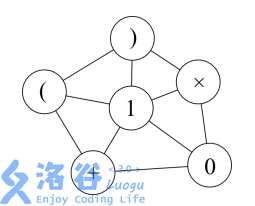
There are walks in total, forming the expressions 101, (1), 1+1, 1+0, 1*1, 1*0, 0+0, 0+1, 0*0, 0*1.
Translated by ChatGPT 5
 京公网安备 11011102002149号