

[CCC 2026 S5] On the Fence
Description
You recently inherited a beautiful plot of land, which can be viewed as a grid with rows and columns. Now you want to protect your land from trespassers by building a giant fence on it. You will build this fence by choosing up to grid cells and filling each of them with a concrete block; these cells are on the fence. Due to mysterious construction laws, the cell in row and column must be on the fence. Also, the fence cells must form a single connected component—you should be able to get between any two cells on the fence by moving vertically or horizontally (not diagonally) through fence cells only.
The cells in row 1, column 1, row , and column are called edge cells. A cell not on the fence is outside the fence if you can get from that cell to an edge cell by moving vertically, horizontally, or diagonally, without going through any fence cells. Otherwise, the cell is inside the fence. The figure below shows some examples of valid and invalid fences.
:::align{center}
 :::
:::
You want to protect as much of your land as possible. Find the largest number of inside cells you can enclose within your fence.
Input Format
The first line of input contains an integer , the number of test cases in the input.
The next lines each contain a test case, consisting of five space-separated integers: , , , , and (, , ).
Output Format
Output lines. The -th line should contain a single integer, the answer to test case .
2
5 6 12 3 4
3 6 18 2 4
4
3
Hint
Explanation of Output for Sample Input
Below are optimal fences for the two test cases, which enclose 4 and 3 inside cells, respectively:
:::align{center}
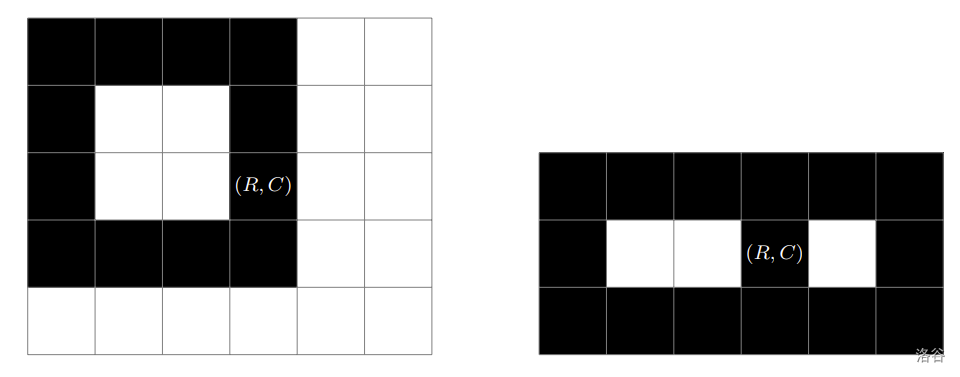 :::
:::
The table on the next page shows how the available 15 marks are distributed.
| Marks Awarded | Bounds on | Bounds on | Additional Constraints |
|---|---|---|---|
| 1 mark | |||
| 2 marks | None | ||
| 3 marks | |||
 京公网安备 11011102002149号