
#P15516. [BalticOI 2007] Building a Fence (Day 2)

[BalticOI 2007] Building a Fence (Day 2)
Description
Leopold is indeed a lucky fellow. He just won a huge estate in the lottery. The estate contains several grand buildings in addition to the main mansion, in which he intends to live from now on. However, the estate lacks a fence protecting the premises from trespassers, which concerns Leopold to a great extent. He wants to build a fence and, in order to save money, he decides it is sufficient to have a fence that encloses the main mansion, except for one important restriction: the fence must not lie too close to any of the buildings. To be precise, seen from above, each building is enclosed in a surrounding forbidden rectangle within which no part of the fence may lie. The rectangles’ sides are parallel to the - and -axis. Each part of the fence must also be parallel either to the -axis or the -axis.
Help Leopold to compute the minimum length of any allowed fence enclosing the main mansion.
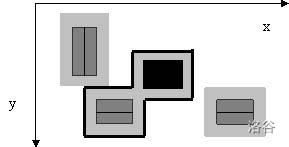
Figure 1: The main mansion (black) and three other buildings with surrounding forbidden rectangles. The thick black line shows a shortest allowed fence enclosing the main mansion.
Input Format
The first line of the input contains a positive integer (), the number of buildings on the estate. Then follow lines each describing a forbidden rectangle enclosing a building. Each row contains four space-separated integers , , , and , where are the coordinates of the upper left corner and are the coordinates of the bottom right corner of the rectangle. All coordinates obey and . The first rectangle is the forbidden rectangle enclosing the main mansion.
Output Format
The output contains one line with a single positive integer equal to the minimum length of any allowed fence enclosing the main mansion.
4
8 4 13 8
2 1 6 7
4 7 9 11
14 7 19 11
32
Hint
In of the test cases, holds.
 京公网安备 11011102002149号